

On 26 February, SpongeWorks was officially launched in Aughrim, County, one of its eight Associated Regions. The event drew over 90 attendees, reflecting strong local interest in Nature-based Solutions for climate and water resilience – just weeks after the area was hit by severe flooding during Storm Chandra.
Tackling Floods with Nature and Community
In late January 2026, the region was severely hit by Storm Chandra. Heavy rainfall overnight saw a rapid rise in river levels across the catchment. 50 houses and several businesses were impacted by flooding. There were also reports of damage to properties, damage and flooding across local road networks and development of gullying in the uplands. The farming community face challenging circumstances with the land to saturated to allow for use by livestock or machinery.
Wicklow has joined the SpongeWorks Associated Regions to pioneer Nature-based Solutions across its landscapes, strengthening flood resilience, boosting biodiversity, and improving water quality, with the ambition of becoming a leader in climate adaptation and community-driven innovation. As part of a collaborative learning network, SpongeWorks Associated Regions share knowledge, build capacity, and scale up sponge solutions, helping to enhance climate and water resilience not just locally, but across Europe.
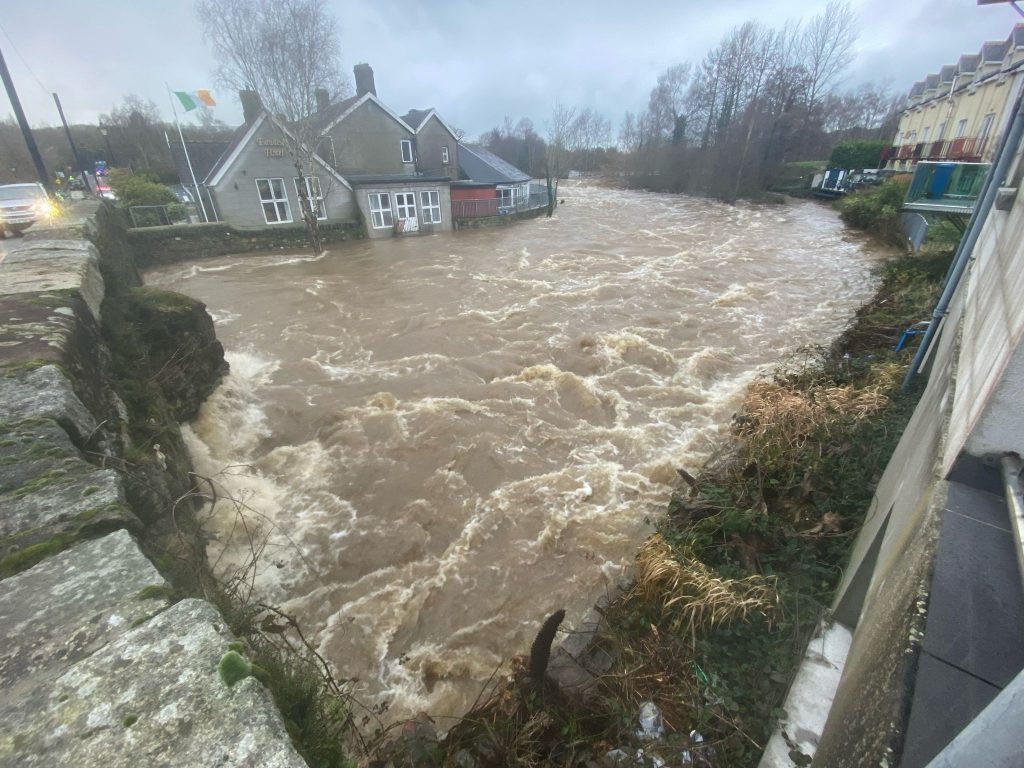
In late January 2026, Storm Chandra triggered rapid river rises and flooding across the catchment, damaging homes, businesses and roads.
The launch featured talks from Chairperson Cllr. Melanie Corrigan who highlighted the power of local knowledge and community involvement in climate action, and Professor Mary Bourke of Trinity College Dublin, who explored the evolving challenges facing catchments and landscapes in a changing climate.
Jim Callery, Wicklow County Council’s Climate Action Officer, highlighted the lessons from the recent flooding during Storm Chandra, stressing the urgent need for practical, locally tailored measures to build resilience across the catchment. He emphasised the importance of collaboration between councils, NGOs, stakeholders, and communities to deliver lasting results and explained that by joining SpongeWorks, Wicklow aims to upscale these approaches, turning recent flood challenges into a blueprint for stronger, nature-driven water management across the county.
Community at the Heart of Resilience
Attendees included businesses, farmers, landowners and local groups such as the Tidy Towns committees from Aughrim and Annacurra. A wide range of stakeholder groups including farm advisory services, inland fisheries, the Office of Public Works, who have responsibility for flood relief, the National Parks and Wildlife Service and two universities attended.
During the meeting, they took part in an interactive workshop, mapping the catchment, sharing flood experiences, and contributing historical knowledge. The message was clear: resilient landscapes require more than science and engineering – they need partnership, local insight, and hands-on engagement.
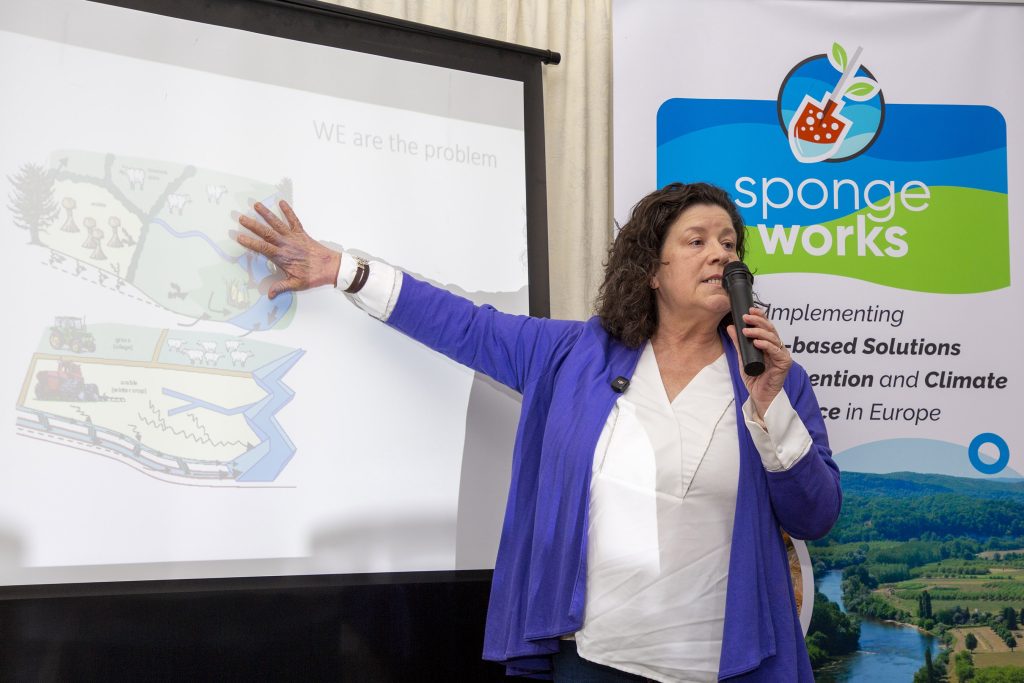
Professor Mary Bourke of the School of Geography at Trinity College, Dublin explaining catchment management stated “We are now living in climate change. Our weather patterns are beginning to show this, and we are increasingly experiencing weather extremes. We can’t restore what we have lost but through Nature-based Solutions can rebuild capacity within our river catchment and reduce flooding risk. (© Mick Kelly)
As Wicklow County Council’s Chief Mr. Emer O Gorman noted: “The flooding in Aughrim had a devastating impact on the community. We need to rethink water management in the landscape. Nature-based Solutions must be part of our strategy to build climate resilience in partnership with our communities.”
From Pilot to European Scale
Associated Regions are Europe’s frontline innovators in Nature-based Solutions. Selected by SpongeWorks, eight regions across diverse climates—from Mediterranean to Alpine—receive tailored support to develop and scale “sponge measures” that slow floods, store water, and restore ecosystems. Each region, led by local authorities and land managers, is at a different stage of its sponge journey, from pilot projects to full-scale implementation. By testing, refining, and sharing solutions across borders, these Associated Regions are shaping a pan-European approach to climate resilience, turning local water and land challenges into models for sustainable, nature-driven adaptation.
For more on Wicklow’s participation to SpongeWorks as an Associated Region , visit (https://www.spongeworks.eu/nature-based-innovation-in-wicklow-ireland-joins-spongeworks-to-restore-river-resilience/)
Feature photo: Jim Callery Wicklow County . Council. Lorna Kelly Wicklow Uplands Council, Prof. Mary Burke Trinity College Dublin, Melanie Corrigan and Hannah O Kelly Wicklow County Council, Eanna Gallagher and Justin Ivory LAWPRO
The SpongeWorks project has received funding from the European Union’s Horizon Europe research and innovation programme under grant agreement No 101156116 and from the UK Research and Innovation/HM Government. The project runs from 1 September 2024 to 31 August 2028.
Views and opinions expressed are those of the author(s) only and do not necessarily reflect those of the European Union or the granting authority, the European Climate, Infrastructure and Environment Executive Agency (CINEA). Neither the European Union nor the granting authority can be held responsible for them.
