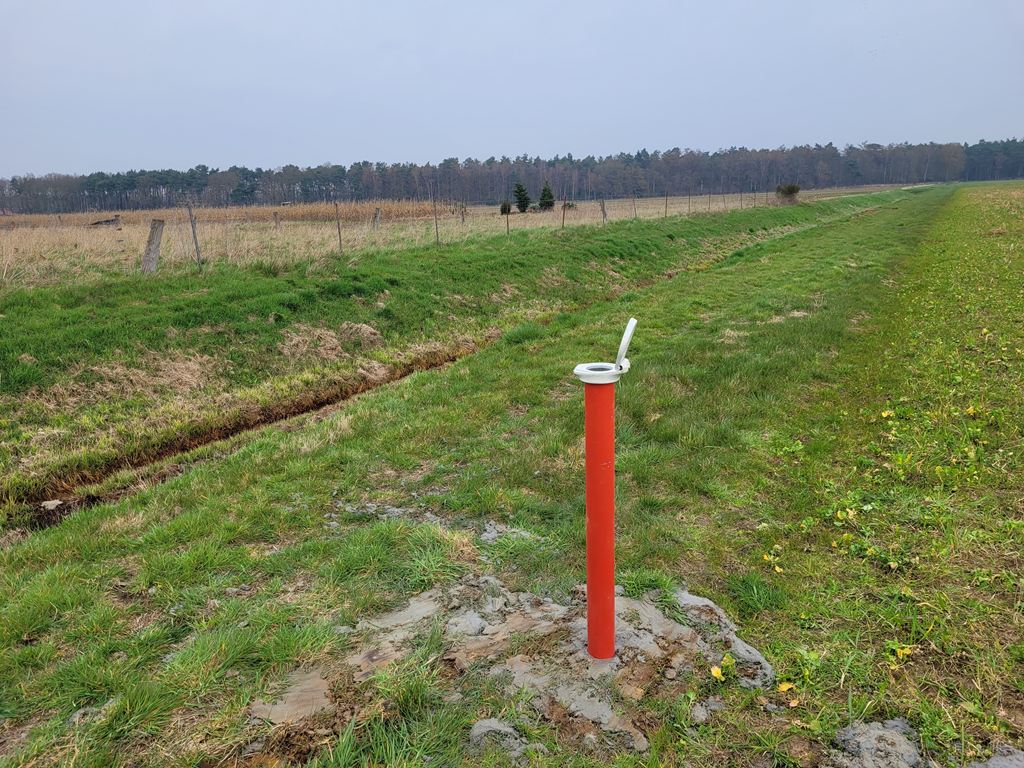
New monitoring stations have been installed along the Engdener Bach and Kruhbecke waterways in the Samtgemeinde Schüttorf area of the Vechte basin in Grafschaft Bentheim, Germany marking an important step in strengthening regional climate resilience. The information collected will play a key role in evaluating the effectiveness of local water retention measures aimed at reducing flood risks, improving groundwater recharge, and increasing resilience to drought.
Groundwater monitoring wells systematically record water levels and are read regularly.
Equipped with advanced data loggers, the stations continuously track both surface water and groundwater levels, generating vital scientific data to better understand how water moves through the landscape.
Beyond the local impact, the findings are expected to help shape future nature-based water management projects and provide valuable guidance for other regions facing similar climate challenges.
Plans are also in place to install adjustable weirs and bed ramps to hold back water and replenish groundwater. A concept for these measures has already been developed by a Berlin-based consultancy under the lead of the Vechteverband water authority, with input from local farmers and other stakeholders who helped identify suitable sites.
The goal is to find ways to store water in the landscape — in groundwater and surface waters — much like a sponge. Water should be retained across a wider area, and groundwater recharge should be actively promoted.
Tessa Clemens – Project Coordinator
In the municipality of Schüttorf, gauges measure the water levels of the Engdener Bach, the Kruhbecke and the Stichgräben.
“To assess the effectiveness of the water retention measures, comprehensive monitoring is of course essential — which is why we installed the measuring stations,” added Ms. Clemens
The Vechte river catchment area in Grafschaft Bentheim and the Netherlands is one of three European pilot regions involved in the initiative, alongside demonstrators in the Lèze valley (Fr) and Pinios (Gr).
The SpongeWorks project has received funding from the European Union’s Horizon Europe research and innovation programme under grant agreement No 101156116 and from the UK Research and Innovation/HM Government. The project runs from 1 September 2024 to 31 August 2028.
Views and opinions expressed are those of the author(s) only and do not necessarily reflect those of the European Union or the granting authority, the European Climate, Infrastructure and Environment Executive Agency (CINEA). Neither the European Union nor the granting authority can be held responsible for them.
Photos: Grafschaft Bentheim District