

On 16 March the second in a series of four Geodesign workshops was held at the headquarters of Waterschap Vechtstromen in Almelo, the Netherlands, bringing together approximately 25 Dutch and German stakeholders. Its aim was to translate regional water management visions into concrete landscape designs.
Turning Vision into Action for the Vecht_e Region
Conducted bilingually in Dutch and German, participants were divided in working groups built on visions first developed in October 2025. This time, the emphasis shifted decisively from abstract thinking to concrete, actionable scenarios—bringing the future into sharper focus.
Participants revisited earlier concepts and highlighted critical shortcomings. Water quality had been underrepresented, stream systems insufficiently integrated, and industrial as well as recreational impacts largely overlooked. The call was clear: future planning must embrace multifunctional land use—connecting water management with agriculture, energy production, and cross-border knowledge exchange.
A central theme of discussion was cross-border water governance. Key questions emerged around how much water can flow from Germany into the Netherlands during peak discharge events and what agreements are needed to manage this safely. Differences in landscape added complexity: the Netherlands’ flat terrain allows for relatively straightforward water retention, while Germany’s varied elevation demands more technical solutions.
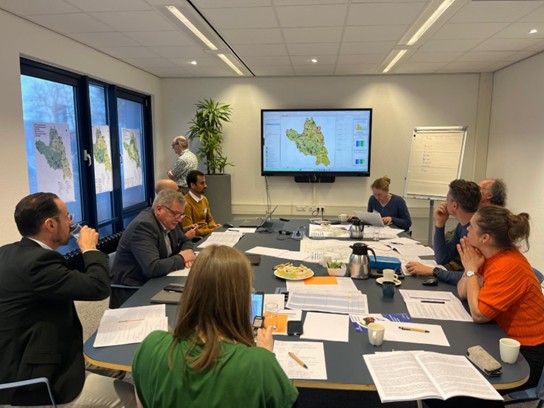
Conducted bilingually in Dutch and German, participants collaborated in mixed working groups.
From Diverging Interests to Shared Priorities
During hands-on co-design sessions, participants mapped priority areas for implementing sponge strategies—approaches that enhance the land’s natural ability to absorb and retain water. Flood safety was confirmed as the top priority, with all interventions required to preserve or offset retention capacity.
Importantly, the discussions revealed a shift in mindset. Rather than framing competing land uses as “conflicts,” participants began to speak in terms of “priorities,” signaling a more constructive and solution-oriented approach.
The workshop also underscored the importance of sustained dialogue with landowners and a long-term, 50-year vision for land-use transformation. Collaboration across sectors and borders will be essential to achieving meaningful progress.
The outcomes of this session mark a significant step forward in addressing the cross-border sponge challenge. Insights gathered will now be combined with survey data from both countries, laying the groundwork for the next phase. Workshop 3 is scheduled for Monday, 5 October 2026, where the evolving strategies will be further refined.
The SpongeWorks project has received funding from the European Union’s Horizon Europe research and innovation programme under grant agreement No 101156116 and from the UK Research and Innovation/HM Government. The project runs from 1 September 2024 to 31 August 2028.
Views and opinions expressed are those of the author(s) only and do not necessarily reflect those of the European Union or the granting authority, the European Climate, Infrastructure and Environment Executive Agency (CINEA). Neither the European Union nor the granting authority can be held responsible for them.
