


The Lower Tisza District in Hungary, is a region severely affected by water scarcity.
We spoke with Dr. Zsuzsanna Hajdu PhD, head of the Land Drainage and Irrigation Department of the Lower Tisza District Water Directorate, to better understand the region, the application of sponge measures and the importance of Spongeworks.
What sparked the project in the Lower Tisza Valley?
The region is a severely drought-prone area in Hungary. Growing water stress, increasing water scarcity and rising temperatures are placing unprecedented pressure on water resources, especially in agriculture. These trends are leading to extreme water balance situations, with severe socio-economic and environmental consequences, including the potential for conflicts over access to water.
Outdated canal networks are often no longer fit for irrigation, forcing farmers to rely heavily on groundwater extraction during dry periods, a practice that is unsustainable in the long term.
At the same time, there is untapped potential: numerous privately owned areas could serve as key sites for water retention, offering an opportunity to capture and store water more effectively. Unlocking this potential will be critical to building resilience and securing the future of agricultural production in a changing climate.
Why did you want to join SpongeWorks?
We are working to find innovative and practical solutions to improve water management strategies and introduce sponge measures in the Lower Tisza Valley. Although water retention practices are still in their early stages, this initiative aims to extend and apply successful approaches to other regions in Hungary and across the Hungarian-Romanian-Serbian cross-border region, in close cooperation with partner institutions.
Through collaboration with experienced organisations and institutions specialising in sponge measures, water retention and water reuse, we are gaining valuable theoretical and practical knowledge. This joint effort enhances our capabilities in co-developing sponge strategies and fosters stronger community engagement and knowledge sharing.
This is an exciting opportunity for us to take part in a Horizon Europe project. Building on our prior experience in preparing Cluster 6 and EU Missions proposals, as well as implementing Interreg cross-border projects, we are well-positioned to make a meaningful impact at the European level.
From our end, we provide valuable insight into Hungary’s water governance system, exploring its unique characteristics, current challenges and future potential. By gathering on-site experiences in regions highly vulnerable to drought, the project has a rich knowledge base, grounded in real-world conditions.
The best practices emerging from the Lower Tisza Valley, where available water resources are critically limited during dry periods, have the potential to serve as replicable models for similar drought-prone areas.
Through the co-creation of sponge measures, the project will generate tangible evidence of the feasibility, replicability and scalability of the proposed solutions tested under a variety of climatic, environmental and socio-economic conditions.
What is your experience with sponge measures so far?
In our region, sponge measures, Νature-based Solutions that help landscapes absorb, retain and slowly release water, are still in their early stages of development. However, momentum is building, with a number of promising initiatives already underway.
Notable efforts include the rehabilitation of wetlands led by ATIVIZIG (the Lower Tisza District Water Directorate) and local municipalities, helping to restore natural water cycles and boost ecosystem health. At the grassroots level, small-scale water retention interventions driven by community initiatives are also beginning to make an impact, showcasing the power of local action.
These efforts are supported by broader investments in water supply and infrastructure development, laying the foundation for more integrated solutions.
Importantly, cross-border cooperation between Hungary and Serbia is advancing plans for a multi-level water retention and aquifer recharge system, which is an ambitious step towards managing shared resources more sustainably. Together, these efforts signal a growing commitment to building climate-resilient landscapes and communities through sponge measures.
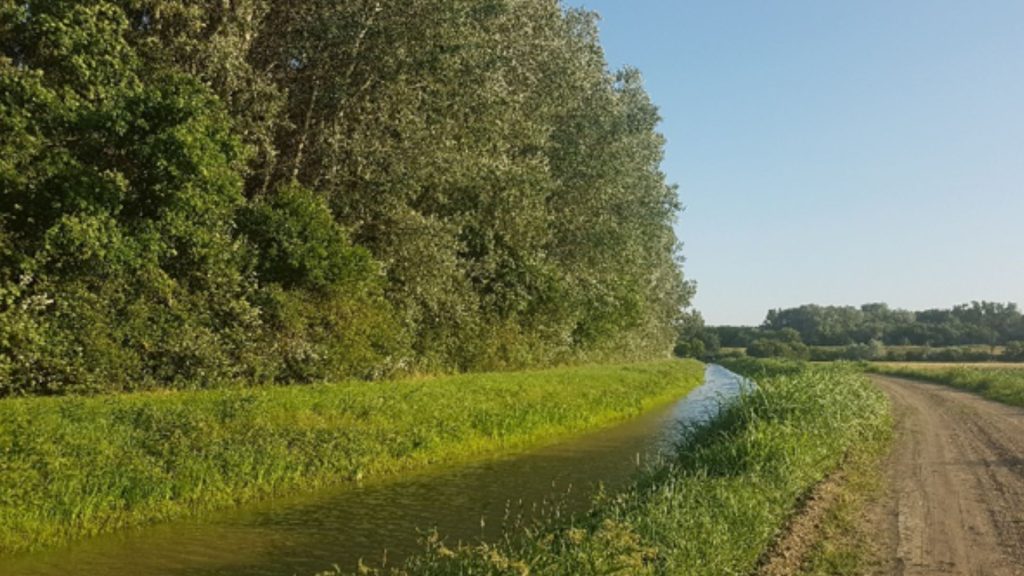
Best practices emerging from the Lower Tisza Valley, where available water resources are critically limited during dry periods, have the potential to serve as replicable models for similar drought-prone areas.
Who is behind the project?
The Lower Tisza District Water Directorate (ATIVIZIG), as a regional, public water management company, is responsible for surface and groundwater resource management in the Lower Tisza Valley. The tasks of ATIVIZIG include flood control, land drainage, water quality and hydrographic monitoring, and the provision of irrigation water for agricultural and industrial water users. Furthermore, ATIVIZIG is also responsible for the operation and development of the water management infrastructure.
Why is this project important beyond the Tisza Basin?
A new wave of climate adaptation efforts is underway, driven by partnership and close cooperation with local stakeholders and communities. At the heart of these initiatives is a focus on increasing water retention, helping to recharge groundwater and build long-term resilience against droughts and floods.
A paradigm shift in stormwater management is taking place, emphasising the use of reused and reclaimed water and moving away from conventional ‘grey’ infrastructure towards Nature-based Solutions. These approaches not only support sustainable water management, but also offer environmental and economic benefits.
Projects on the ground are already producing evidence of the feasibility, replicability and scalability of solutions such as wetland restoration and water retention interventions. These successes are paving the way for the application of proven methodologies in other regions, helping scale impact beyond the pilot sites.
Most importantly, these efforts are strengthening collaboration with local populations, ensuring the innovations are grounded in community needs and supported by those who will benefit from them the most. Through co-creation and knowledge sharing, a more resilient, sustainable and water-smart future is within reach.
The SpongeWorks project has received funding from the European Union’s Horizon Europe research and innovation programme under grant agreement No 101156116 and from the UK Research and Innovation/HM Government. The project runs from 1 September 2024 to 31 August 2028.
Views and opinions expressed are those of the author(s) only and do not necessarily reflect those of the European Union or the granting authority, the European Climate, Infrastructure and Environment Executive Agency (CINEA). Neither the European Union nor the granting authority can be held responsible for them.