


As climate change accelerates, Ireland is taking a bold step toward building resilience, not with concrete, but with nature. Wicklow County Council and its local partners have joined the EU-funded SpongeWorks initiative to pilot Nature-based Solutions that reduce flood risk, improve water quality, and protect biodiversity in the upper Aughrim River catchment.
We spoke with James Callery, Climate Action Officer at Wicklow County Council, to understand what this means for the region.
What sparked your project? What makes the Aughrim River catchment unique?
The Aughrim sub-catchment is part of the larger Avoca catchment, one of Ireland’s least-altered river systems. It flows from upland areas, through a farmed landscape, and into urban centers. But like many places, it’s under pressure due to land management that is impacting on water quality. Threats include overgrazing and afforestation in the uplands, urban runoff that ends up to the river, intensification of farming as well as modification of channels. On top of all that there has been a 7% increase in rainfall over recent decades. That’s why we need a new way of managing water, one that works with nature, not against it.
What inspired Wicklow to join SpongeWorks?
Our goal is to become a leader in climate adaptation. By joining SpongeWorks, we’re embracing Nature-based Solutions (NbS) to tackle local challenges, such as a fragmented and inadequate approach to water retention at landscape level, and turn them into opportunities through community engagement and environmental innovation.
SpongeWorks gives us a structure to develop a long-term strategy and a chance to compare best practices. It’s about improving our approach, making it measurable, and ensuring it’s adaptable to local needs.
We want to create a cohesive, strategic plan that works across upland, rural, and urban areas.
From our end, we will contribute real-world experience and pilot results from a diverse Irish landscape, upland, agricultural, and urban. We have long-standing experience in stakeholder engagement and we have formed a working group comprised of key stakeholders in Ireland charged with delivering on the protection and restoration of our river catchment, alongside representation for local landowners. These groups have joined forces for the restoration of the river’s water retention capacity.
What is your experience with sponge measures so far and how do you expect to upscale them through SpongeWorks?
Wicklow County Council recognizes through its climate action plan the need to build climate resilience in our uplands and river catchments. National policy and a number of programmes including ACRES, Farming for Nature and Farming for Water have started conversations in rural areas about the role protecting and restoring rivers can play in climate adaptation. Measures being implemented include restoration of peatlands through closure of drains and revegetation, sustainable management of natural grassland pastures, afforestation of gullies, the implementation of riparian buffers on farmland and forest plantations, fencing off of rivers, the development or restoration of wetlands, the development of siltation ponds are all actions being tested and promoted.
Nature-based Solutions such as reducing outflow from drains can reduce flood risk while maintaining farm productivity. An update to a wetland assessment was undertaken in 2010 and will provide a benchmark to explore how wetlands on the catchment are currently functioning and what will be needed to restore their capacity for water storage. Wicklow Uplands Council led on an EIP project called Sustaining Uplands Agriculture-Environment Scheme which aimed to ensure resilience for upland farming systems while protecting the habitat. Moreover, the East Wicklow Rivers Trust alongside Wicklow County Council have been working on removing artificial barriers to fish migration with two barriers removed and a third planned for the study catchment. The East Wicklow Rivers Trust in collaboration with the Wicklow Uplands Council, funded by Wicklow County Council, are currently undertaking an uplands gully planting project.
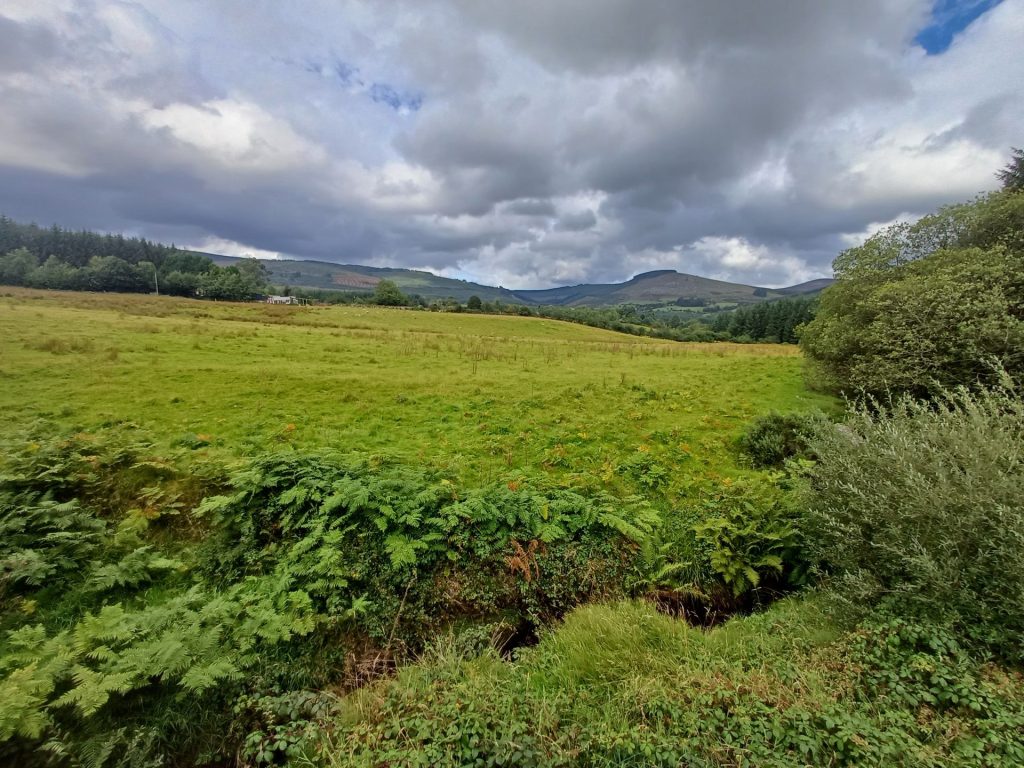
Overgrazing, urban runoff, intensive farming, and channel modification—combined with a 7% rise in rainfall—are putting pressure on the Aughrim River basin.
Who is behind the project?
Wicklow County Council the local authority for County Wicklow, Wicklow Uplands Council a voluntary organization representing the Uplands community, East Wicklow Rivers Trust a group that came together to promote work to protect Wicklow rivers, LAWPRO a shared service of Ireland’s 31 local authorities dedicated to achieving good water quality in Irish water bodies.
What kind of impact do you hope to achieve for your region and beyond?
Our work will show how farmers, landowners, and communities can take the lead in climate resilience. We look forward to becoming part of an international partnership that works for improving water retention at landscape scale. By putting farmers at the heart of planning and implementing water retention measures and showcasing the power of urban sponge solutions, we want to build a strategy to scale up the impact of sponge measures across the catchment, across Ireland, and beyond. The solutions are there. We now need to match them with local landowner and build scale in delivering nature based sponge solutions for Wicklow catchments.
The SpongeWorks project has received funding from the European Union’s Horizon Europe research and innovation programme under grant agreement No 101156116 and from the UK Research and Innovation/HM Government. The project runs from 1 September 2024 to 31 August 2028.
Views and opinions expressed are those of the author(s) only and do not necessarily reflect those of the European Union or the granting authority, the European Climate, Infrastructure and Environment Executive Agency (CINEA). Neither the European Union nor the granting authority can be held responsible for them.