


How do you get the right people around the table to make nature-based solutions really work in combined way across entire landscapes? What happens when those people have very different levels of power—or even completely different ideas of what “solutions” should look like?
To find out, we spoke with the University of Twente team, who are leading the work on governance in SpongeWorks. Their research digs into challenging questions, like how to encourage inclusive participation which yields results beyond the local scale, and how to ensure informal discussions that do not end up wasting stakeholders’ time.
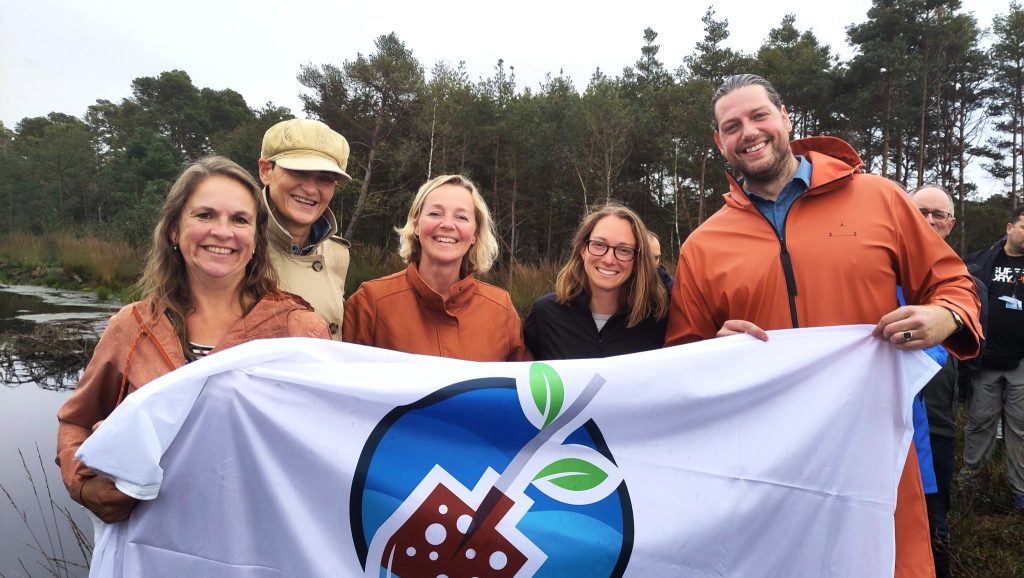
The University of Twente team working on SpongeWorks: (left to right) Maya van den Berg, Janine Swaak, Joanne Vinke-de Kruijf, Kelsey Wentling, Beau Warbroek.
In a nutshell, what is the overall aim of your research & practice in SpongeWorks?
At University of Twente we want to better understand how stakeholders can collaboratively develop and implement nature-based solutions. In particular we explore a. how to ensure inclusivity and justice; and b) how to connect and embed co-creation processes into formal policy processes.
What does a ‘multi-actor approach’ mean in practice?
The decision on whom to involve, when, how and why, depends on what is required or desired, e.g. because of local history and customs or because of prevailing policy or legislation. Our role as researchers is not to prescribe who to engage, but, recognising context-specific factors and circumstances, to provide a structured overview of the available options. We encourage actors to be inclusive, which implies considering stakeholders who are less obvious, such as future generations or even non-human stakeholders, such as the river, or nature itself.
We encourage actors to be inclusive, also considering stakeholders such as future generations or nature itself.
What happens when different actors have very different political influence or bargaining power?
Political influence and power relations are crucial to consider, especially in terms of how power dynamics influence what we consider to be just and inclusive processes and outcomes. Understanding who has what kind of influence and power is a crucial first step, also to prevent raising expectations that cannot be met.
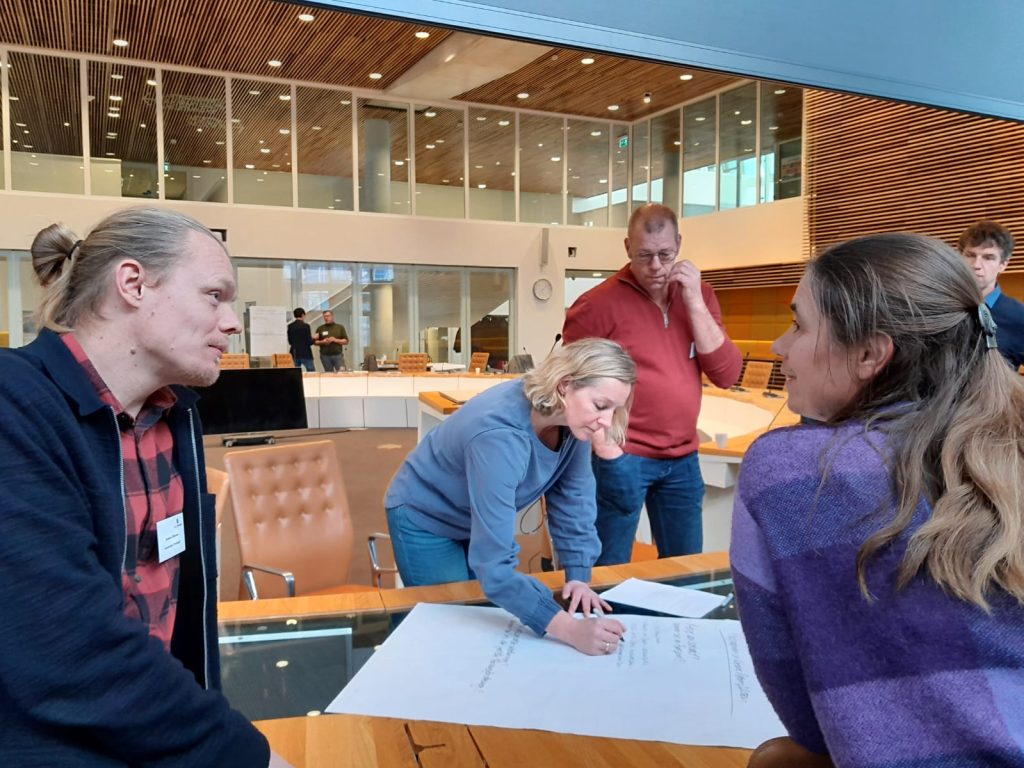
Joanne guides the governance assessment workshop at the kick-off meeting at the Vecht demonstrator.
What has SpongeWorks learnt and taken into account from previous failures in this and other respects relating to stakeholder engagement?
From previous research and practical experience, we learned that for collaborative processes to have an actual impact, it’s critical to consider the linkage between these often informal processes, with the formal policy processes. While informal processes are great for innovation and learning, they may not yield tangible results. From experience, we know that nothing is more disappointing for stakeholders than investing time and other resources in a process that does not lead to any form of implementation*.
Nothing is more disappointing for stakeholders than investing time and other resources in a process that does not lead to any form of implementation.
What are sponge ‘strategies’ which SpongeWorks is promoting? And what do mean by ‘landscape scale’?
Sponge measures are local interventions that aim to improve the capacity of soil and water systems for infiltration or storage of water. Such interventions can be taken by a wide range of stakeholders, including individual farmers, nature organizations, water management authorities, and so on. In SpongeWorks we want to better understand how these local interventions add up at the level of an entire river basin. This includes the water system itself (groundwater and surface water) as well as the entire landscape on which the rain falls that is eventually collected in the water system.
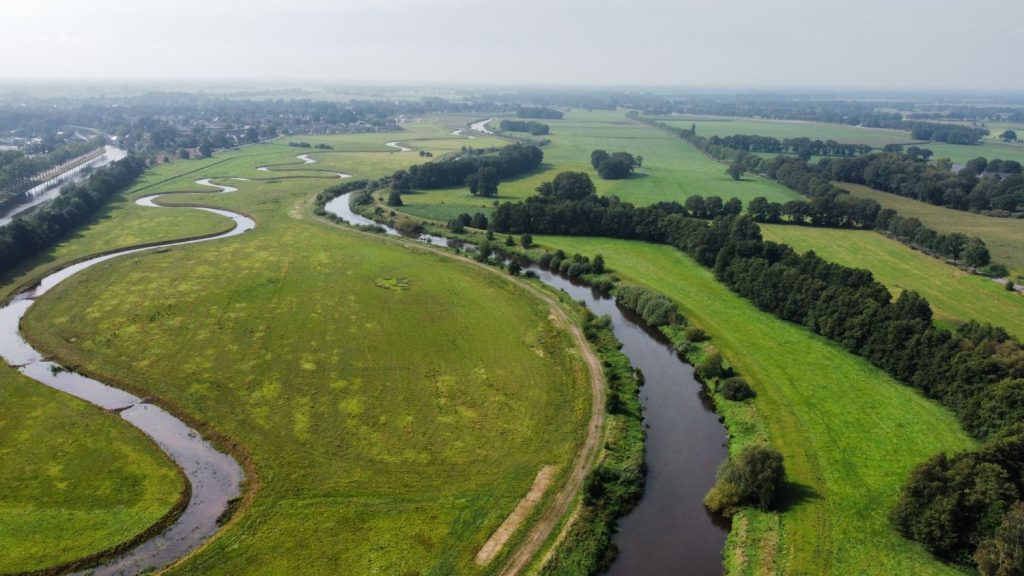
The Vecht river basin, one of the 3 SpongeWorks large-scale demonstrators. The aim is to combine individual sponge measures into overall strategies that have a measurable impact on the landscape scale.
Who do we expect to be the driving force for NbS at landscape scale?
Sponge strategies require involvement and support of stakeholders whose responsibility goes beyond a local measure. Depending on the local governance context, this can include actors who are responsible for river basin management as well, or with a role in spatial planning and management of soil. They could be a regional government, a water management authority or a farmers’ association. By definition, no single actor has all the necessary resources (e.g. human resources, funding, legal authority, organisation capacity etc.) to achieve sponge strategies by itself. Therefore, collaboration across a wide variety of actors (public, private, civil society) from different sectors is essential.
Who are the main members of the team working on this?
At the University of Twente, Kelsey Wentling will work full-time on SpongeWorks as part of her PhD research project. Kelsey is supervised by Prof. Leentje Volker, Joanne Vinke-de Kruijf, Beau Warbroek and Robert-Jan den Haan. Joanne is also responsible for coordinating the project on behalf of the University of Twente. Beau has a leading role in the organization of the Governance Assessment workshops in the three demonstration basins. Our colleague Kris Lulofs is an expert in water governance and contributes to the governance assessment workshops. Our colleagues from DesignLab, Maya van den Berg and Janine Swaak, are taking a leading role in stakeholder management in the transboundary Vecht basin and support us with the design of workshops.
As a team we are committed to co-producing scientific knowledge while also making a difference in the transboundary Vecht basin. As we speak, we are also involved in two other research projects on the same basin. We make sure that we coordinate across these projects and would like to build a stakeholder network that lasts beyond these individual projects.
*The Governance Assessment Tool that has been developed by the University of Twente has turned out to be a very useful means to getting a better grip on the governance context. The tool provides actors involved with a better understanding of the elements that jointly make up a governance setting: the multiple levels and scales, variety of actors and networks, the diversity of problem perspectives and goal ambitions, the variety of strategies and instruments, and the resources and responsibilities that influence implementation. In addition, the tool includes a series of questions that can help to create an inventory of supportive and restrictive elements. These questions are related to the completeness and coherence of the governance setting as well as to pressure for change and flexibility in case changes are needed to allow for implementation.